
Water 101 · 11 min read
Is Your Water Safe for Baby Formula? A Parent's Guide to Testing and Filtering
By Mick Preston, Co-founder · September 2026
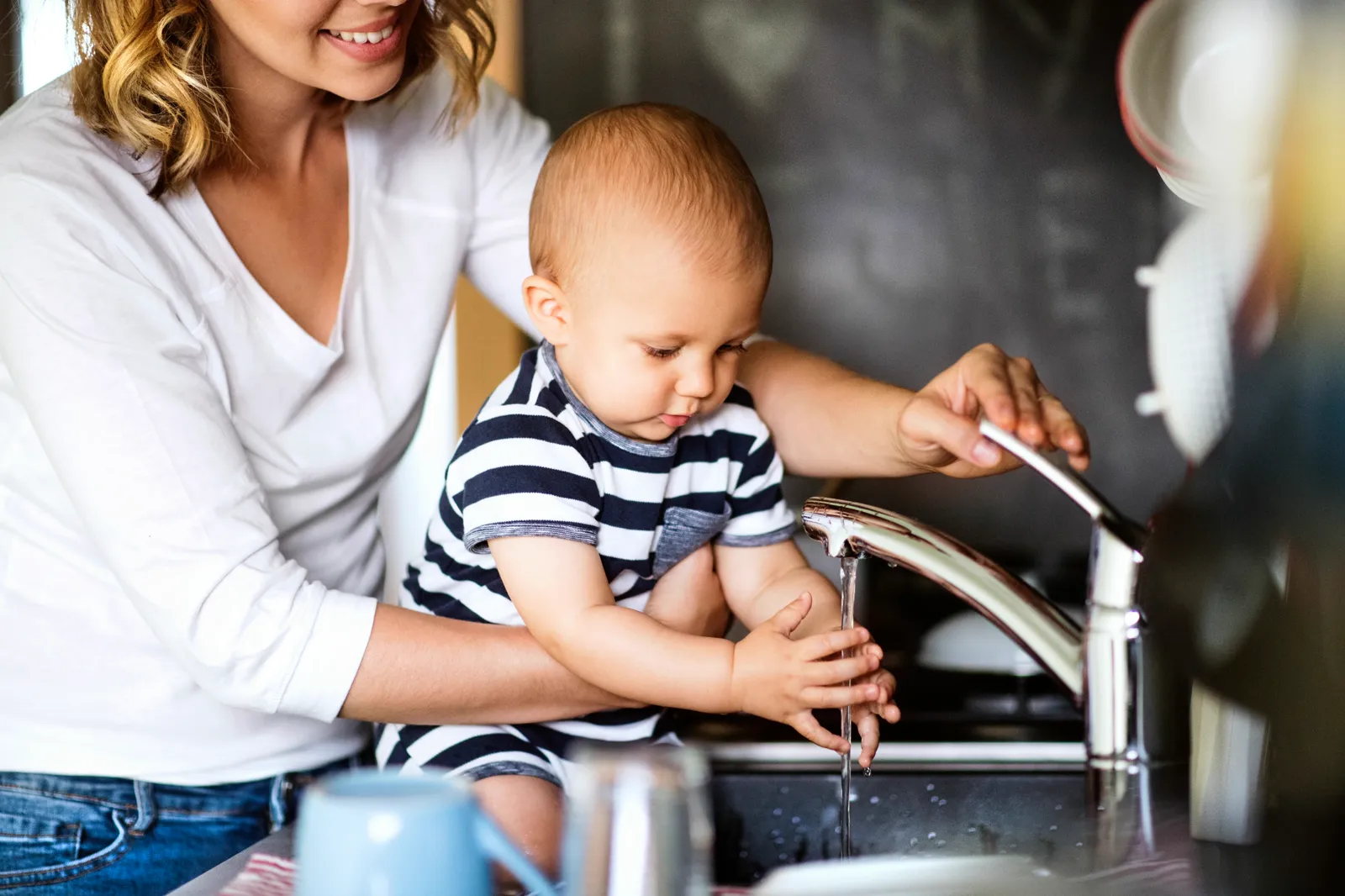
There's no single "safe water" answer for formula — it depends on what's actually in your water. Lead, nitrates, PFAS, and fluoride each matter differently for an infant than for an adult, and most of them don't announce themselves by taste, smell, or color. The reliable sequence is: find out what's in your water (your utility's Consumer Confidence Report, or a real test if you're on a well), then choose filtration matched to what that shows — not a guess between tap, bottled, or well water by default.
New parents ask me a version of the same question: "Is our water actually okay for the baby?" It's a fair question, and an uncomfortable one, because the honest answer is usually "it depends on your specific water" rather than a clean yes or no. That's not a dodge — it's the same answer I give well owners about arsenic and iron. Water quality is address-by-address, and formula is the one thing in a house where an infant's entire fluid intake can run through whatever comes out of your tap.
Why Water Matters More When You're Mixing Formula
An adult drinking a glass of tap water with trace lead or nitrates is a very different exposure than a baby whose formula is mixed with that same water several times a day, every day, for months. Infants take in a large volume of water relative to their body size, and for a formula-fed baby, that water is often a primary source of daily hydration and nutrition — not an occasional glass. The CDC notes that this is why infants who drink formula made with lead-contaminated tap water may be at higher risk of exposure.[4] It is also why some drinking-water limits, like the nitrate standard below, are written around infant risk specifically rather than an average adult.
Lead: No Safe Level of Exposure
Lead is the one I'd put first on any parent's list. It's tasteless, odorless, and invisible, and it almost never comes from the source water itself — it leaches from lead service lines, old solder, and older fixtures on the way to your faucet, which means it's a plumbing problem, not just a water-source problem.[1] Our companion piece on what's really in Salt Lake City's tap water covers the local picture: the city estimates 9,402 to 14,457 lead service lines and secured a $39 million loan in 2024 for a five-year replacement project. The EPA's health goal for lead is zero because it says there is no safe level of exposure, and lead can cross the placental barrier during pregnancy. The EPA estimates that infants who consume mostly mixed formula can receive 40 to 60 percent of their lead exposure from drinking water.
Nitrates: The One the EPA Regulates Specifically for Infants
Nitrates are the clearest example of a contaminant where the regulation exists because of babies. The EPA's own language on its primary drinking water standard is direct: infants below the age of six months who drink water containing nitrate in excess of the 10 mg/L limit could become seriously ill and, if untreated, may die, with symptoms including shortness of breath and "blue baby syndrome" (methemoglobinemia) — the body's reduced ability to carry oxygen in the blood.[2] Nitrates have no taste, smell, or color, so a family cannot tell by drinking the water whether it's a concern. They're most common in private well water near agricultural land or older septic systems, which is why our well water and baby formula guide goes deeper on testing for it.
PFAS and Fluoride: Smaller Doses, Longer Exposure
Lead and nitrates are the first two to check; PFAS and fluoride come next — and the same "smaller body, more water" logic applies. PFAS ("forever chemicals") persist in the environment and the body. The EPA notes that formula made with water containing PFAS can expose infants to PFAS, and lists developmental effects in children, including low birth weight, among the health effects it is studying.[5] Our PFAS guide covers what it is and what reduces it. Fluoride is added to many municipal systems for dental health (Utah no longer allows it to be added), and the American Dental Association says it is safe to mix formula with fluoridated water. The CDC notes that formula mixed with fluoridated water may increase the chance of mild dental fluorosis if formula is a child's main food, and that parents can use low-fluoride bottled water some of the time to lessen this. Ask your pediatrician or dentist what fits your baby.[6]

City Water or Well Water? Start Here
The right first move is different depending on your water source, so figure that out before anything else.
On municipal (city) water: Your utility is required to test for regulated contaminants and deliver a Consumer Confidence Report (CCR) showing what was detected and how it compares to the legal limit.[3] Read it. Our ZIP water report tool pulls up what's typically found in your area's supply as a starting point, with the EPA legal limit next to the stricter health guideline for context.
On a private well: There is no utility and no CCR, and the EPA says private well water is not federally regulated — the well owner is responsible for testing. Geology and local land use determine what's in your well, and two properties a quarter mile apart can test completely differently. A comprehensive test is not optional here; it's the only way to know.
Not sure where to start?
Look up your ZIP for a fast read on what's typically in your local water, or take the 60-second quiz to match a filtration approach to your situation.
Step 1: Test Before You Guess
I say this in almost every article I write, and it's especially true here: treating water you haven't tested is guesswork, and guesswork is a poor basis for a decision about what goes into a baby's bottle. For well families, our well test kit gives a comprehensive panel — including nitrates, bacteria, and the metals covered above — before you commit to any system. For city water, start with your CCR, and consider a point-of-use test if your home has older plumbing, since lead is a household-plumbing issue that a utility-level report can't fully capture.
Step 2: Match Filtration to What the Test Shows
Once you know what you're dealing with, filtration should match it rather than guess at it. For most households mixing formula at the kitchen tap, the 5-stage Sentry H2O Wellness System is our under-sink drinking system: ToxyGuard catalytic-carbon media is aimed at reducing lead, arsenic, chloramines, VOCs, and fluoride, with an AlkaGuard remineralization stage. It installs under the kitchen sink in about 30 minutes without a plumber, and filters are replaced at 3,000 gallons or 1 year, whichever comes first — worth keeping on a strict schedule when the water is going into formula. For well families whose test shows iron, sulfur, nitrates, or bacteria, a whole-house configuration is usually the better fit; see the well water and baby formula guide for that path.
Not every filter is built for this job. A water softener alone, for example, will not remove arsenic, according to the Minnesota Department of Health — the question to ask of any filter is whether it is independently tested for the specific contaminant your test found, not just marketed as "healthier." Salt Lake City's own water report suggests looking for a filter certified by an ANSI-accredited certifier to reduce lead.
A Note on Boiling
Boiling feels like the intuitive safety step, and it does have a real job: it can inactivate some bacteria and parasites. What it does not do is remove lead, nitrates, PFAS, or arsenic — and because boiling reduces water volume through evaporation, it can concentrate the dissolved ones rather than reducing them. Boiling and filtration solve two different problems, which is exactly why we wrote a full piece on it: does boiling tap water make it safe for baby formula?
Not sure where to start?
Answer a few questions about your water and your home and we'll point you toward the right system — no guesswork required.
Frequently Asked Questions
Is tap water safe for mixing baby formula?
It depends on what's in your specific water. Municipal tap water that meets every EPA legal limit can still carry lead from old service lines and household plumbing — a plumbing problem, not a source-water one. The EPA's health goal for lead is zero. Check your utility's Consumer Confidence Report, then filter or test based on what it shows.
Is well water safe for baby formula?
Only a test can tell you. Private wells are not regulated by the federal government under the Safe Drinking Water Act, so nitrates, bacteria, and arsenic can be present with no color, smell, or taste. The EPA's nitrate limit exists specifically because infants under six months are the population most at risk from it. Test before you mix a bottle with well water.
Does boiling tap water make it safe for formula?
Boiling can inactivate some bacteria and parasites, but it does not remove lead, nitrates, PFAS, or arsenic — and can slightly concentrate them as water evaporates. Boiling and filtration solve different problems; most households need to think about both.
What's the safest water for baby formula: tap, filtered, bottled, or well?
There's no single universal answer, because it depends on what's actually in your water. The reliable sequence is: find out what's in your water (a utility report or a real test), then choose filtered tap water treated for what your results show, rather than guessing between tap, bottled, or well by default.
Why are infants more sensitive to contaminants like lead and nitrates than adults?
Infants take in a lot of water relative to their size, and formula made with water is often a baby's primary source of hydration and nutrition for months. The EPA also notes that infants and fetuses are particularly vulnerable to lead. That is why some limits, like the nitrate MCL, are set specifically around infant risk.
Sources
[1] U.S. EPA — Basic Information about Lead in Drinking Water. Lead typically enters water through corrosion of service lines and household plumbing; the EPA's health goal for lead is zero because there is no safe level of exposure, and infants who consume mostly mixed formula can receive 40 to 60 percent of their lead exposure from drinking water.
[2] U.S. EPA — National Primary Drinking Water Regulations. Nitrate MCL is 10 mg/L (measured as nitrogen); the EPA specifically warns that infants under six months who drink water above this limit risk serious illness, including methemoglobinemia ("blue baby syndrome").
[3] U.S. EPA — Consumer Confidence Reports Rule. Public water systems must deliver an annual water quality report to customers showing detected contaminants relative to legal limits.
[4] CDC, About Lead in Drinking Water, and Infant Formula Preparation and Storage (usually safe with tap water; use bottled water or ready-to-feed formula if tap water has harmful chemicals).
[5] U.S. EPA — Our Current Understanding of the Human Health and Environmental Risks of PFAS.
[6] CDC — Community Water Fluoridation FAQs; American Dental Association — Fluoridation FAQs; Utah's May 2025 ban on adding fluoride: Salt Lake City 2026 Water Quality Report.
Keep reading
Educational guidance only — not medical advice. For questions about your baby's specific health needs or formula preparation, talk with your pediatrician. Private well owners should work with a certified laboratory to confirm results before choosing a treatment system.