
Filter guide · 6 min read
What BioChemGuard does, and what we can prove
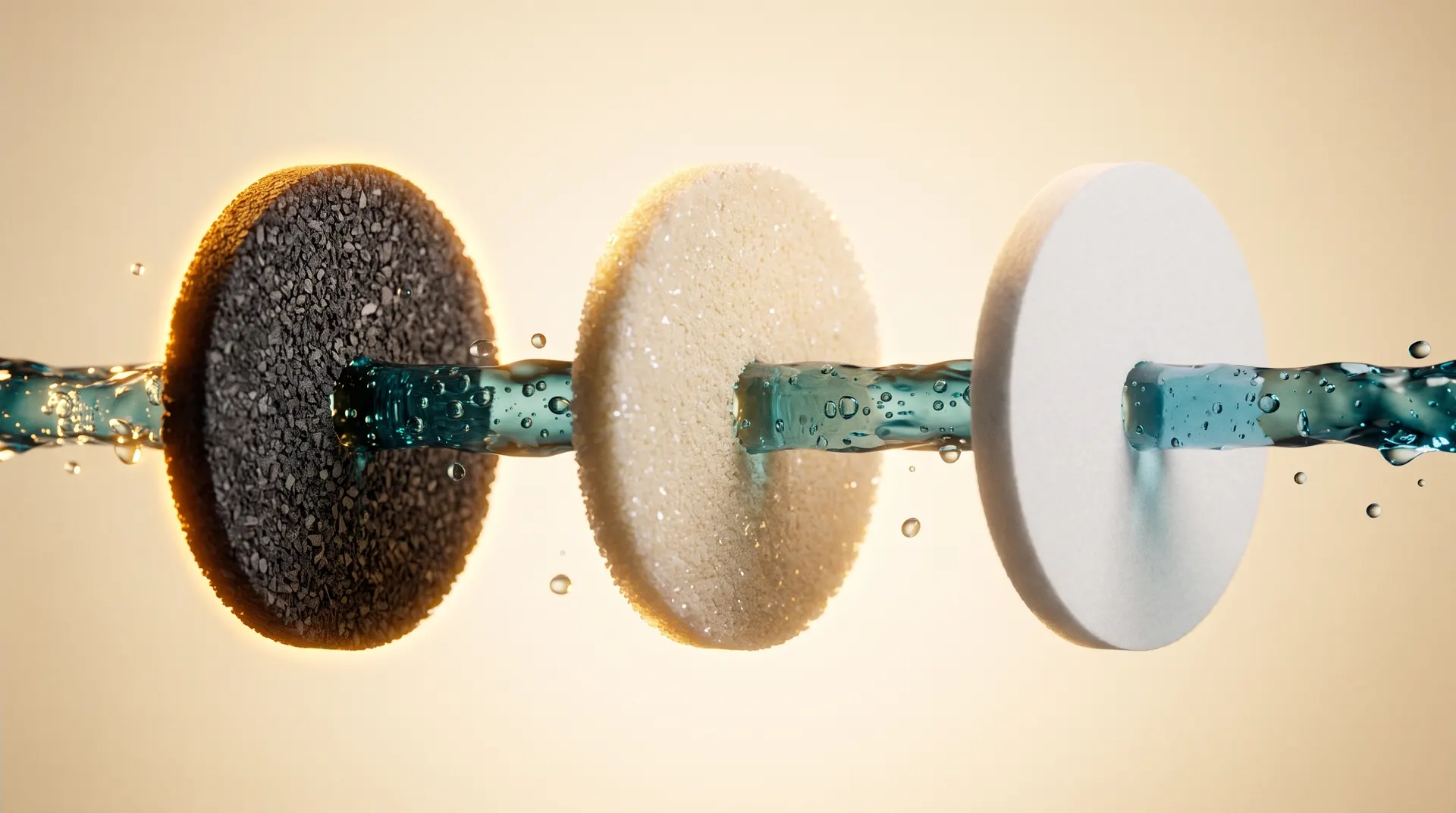
BioChemGuard is the third stage in TriGuard and one of the two stages in the Premium Portable. Sentry confirmed in writing in October 2026 that it uses Argonide NanoCeram PAC, an electropositive media that holds fine particles by charge as well as by size. Argonide’s own media tests report strong figures for fine particles, a test bacterium and cysts.[1] Those are tests of the media, not of the finished Sentry system, and no system certificate for microbial reduction has been published yet.
We sell BioChemGuard, so we want to be exact about it: what the stage is, what its media maker has measured, and where the evidence stops. Here is all of it in one place.
What BioChemGuard is
BioChemGuard is a filter cartridge in two Sentry H2O setups. In the under-sink Wellness System, the TriGuard configuration adds it as a third stage beside ToxyGuard and AlkaGuard. In the Portable System, the Premium Upgrade pairs it with AlkaGuard in two housings.
Until this month we could only say the stage was built, by Sentry’s description, around media from Argonide. On October 20, 2026, Sentry confirmed in writing that BioChemGuard uses Argonide’s NanoCeram PAC media. PAC stands for powdered activated carbon, which Argonide blends into the NanoCeram media.[1] You can see how it sits beside the other two stages on our filters page.
How electropositive media differs from a mechanical filter
Most cartridge filters work like a sieve. Water passes through, and particles bigger than the gaps get stuck. To catch smaller particles, the gaps have to shrink, and the filter gets harder to push water through.
NanoCeram adds a second way to hold particles. Argonide describes it as a thermally bonded blend of microglass and cellulose fibers infused with nanoalumina fibers. The nanoalumina is electropositive, so it attracts and holds fine particles by charge as well as by size. Argonide calls the result a broad-spectrum particle magnet and says it adsorbs particles of virtually all sizes. The technology is NASA-derived.[1]
Because it does not rely on tiny gaps alone, the media can be pleated into a cartridge that keeps flow high and pressure drop low.[1]
What Argonide’s media tests show
These figures come straight from Argonide’s NanoCeram and NanoCeram PAC data sheet.[1]
| Argonide media figure | What it means |
|---|---|
| >99.99% efficiency at 0.2 micron (latex test spheres) | Measured with latex spheres, a stand-in for fine particles. A 0.2-micron particle is far smaller than most sediment. |
| >5 LRV Klebsiella terrigena retention | LRV is a log reduction value, the data sheet’s own unit for how much of a test organism the media held back. Klebsiella terrigena is the test bacterium Argonide reports. |
| >3 LRV cyst retention | Cysts are the hardy, dormant form some waterborne parasites take. |
| >99.95% endotoxin removal | Endotoxins are fragments of bacterial cell walls that can stay in water after the bacteria are gone. |
| Virus: “reduces or removes” | The data sheet lists virus as reduced or removed, but gives no single figure, so we quote none. |
| High flow, low pressure drop | The pleated construction is what lets a media this fine keep water moving. |
These are Argonide’s own media tests of NanoCeram and NanoCeram PAC, not a test or certification of the finished Sentry system. A filter performs differently inside a finished system, at that system’s flow rate and with that system’s housings and seals, so a media result is a starting point, not a system result.
On certification, the data sheet itself sets the scope.[1] The NanoCeram media in BioChemGuard is tested and certified by IAPMO R&T to NSF/ANSI 53 for material safety only. That is a media certification, not a contaminant-reduction certification of the TriGuard or Portable system; Sentry has been asked for the system certificate and scope (2026-10-20).
What is not proven yet
- System microbial performance. TriGuard and the Premium Portable have not been independently tested or certified for bacteria or virus reduction. We have asked Sentry for the system certificate and its scope.
- PFAS and glyphosate. We make no PFAS or glyphosate claim for BioChemGuard. We have asked Sentry for testing of the finished TriGuard system. The PFAS results on our Science page are independent lab tests of water from the full under-sink system, not a BioChemGuard test.
- Your water. No filter figure tells you what is in your own source. A lab test does.
If your water is microbiologically unsafe or of unknown quality, disinfect it before or after the filter. EPA explains how to disinfect drinking water in an emergency.[2]
Who it is for
TriGuard, for well water. If your kitchen tap runs on a private well, near farmland, or after flooding, TriGuard adds BioChemGuard to the two city-water stages. We suggest pairing a well with a lab test, and with UV where microbes are a known concern.
Premium Portable, for emergencies and unverified sources. When you cannot be sure of the source, the Premium Upgrade means you never have to pick a filter stage in the moment. Our emergency preparedness page covers the full kit.
Frequently asked questions
Is BioChemGuard a disinfection stage?
No. It is a filtration media that captures particles by charge and by size. Neither TriGuard nor the Premium Portable has been independently tested or certified for bacteria or virus reduction, so if your water is microbiologically unsafe or of unknown quality, disinfect it before or after the filter.
Does the 99.99% latex-sphere figure describe my TriGuard system?
No. Argonide measured >99.99% efficiency at 0.2 micron (latex test spheres) using latex spheres in a test of its NanoCeram media. These are Argonide’s own media tests of NanoCeram and NanoCeram PAC, not a test or certification of the finished Sentry system. A test of the finished system has not been published.
Is BioChemGuard certified?
The NanoCeram media in BioChemGuard is tested and certified by IAPMO R&T to NSF/ANSI 53 for material safety only. That is a media certification, not a contaminant-reduction certification of the TriGuard or Portable system; Sentry has been asked for the system certificate and scope (2026-10-20).
Does BioChemGuard reduce PFAS or glyphosate?
We make no PFAS or glyphosate claim for BioChemGuard, and the Argonide data sheet does not make one either. The PFAS results on our Science page come from independent lab tests of water from the full under-sink system, not from a BioChemGuard test.
Sources
[1] Argonide Corporation, NanoCeram & NanoCeram PAC Filters data sheet, T-822-05 Rev F (03.28.2023): media features, media retention characteristics and the NSF/ANSI 53 material-safety note. Sentry H2O confirmed the NanoCeram PAC media in writing to Mountain Pure Water on 2026-10-20.
[2] U.S. EPA, Emergency Disinfection of Drinking Water.
Keep reading
Educational guidance only, not medical advice. Mountain Pure Water is an authorized distributor of Sentry H2O, so read our product mentions with that in mind. Media figures are Argonide’s, quoted as published; they are not a test or certification of the finished Sentry system.