
Water 101 · 6 min read
Why your RO drain keeps running, and what to check
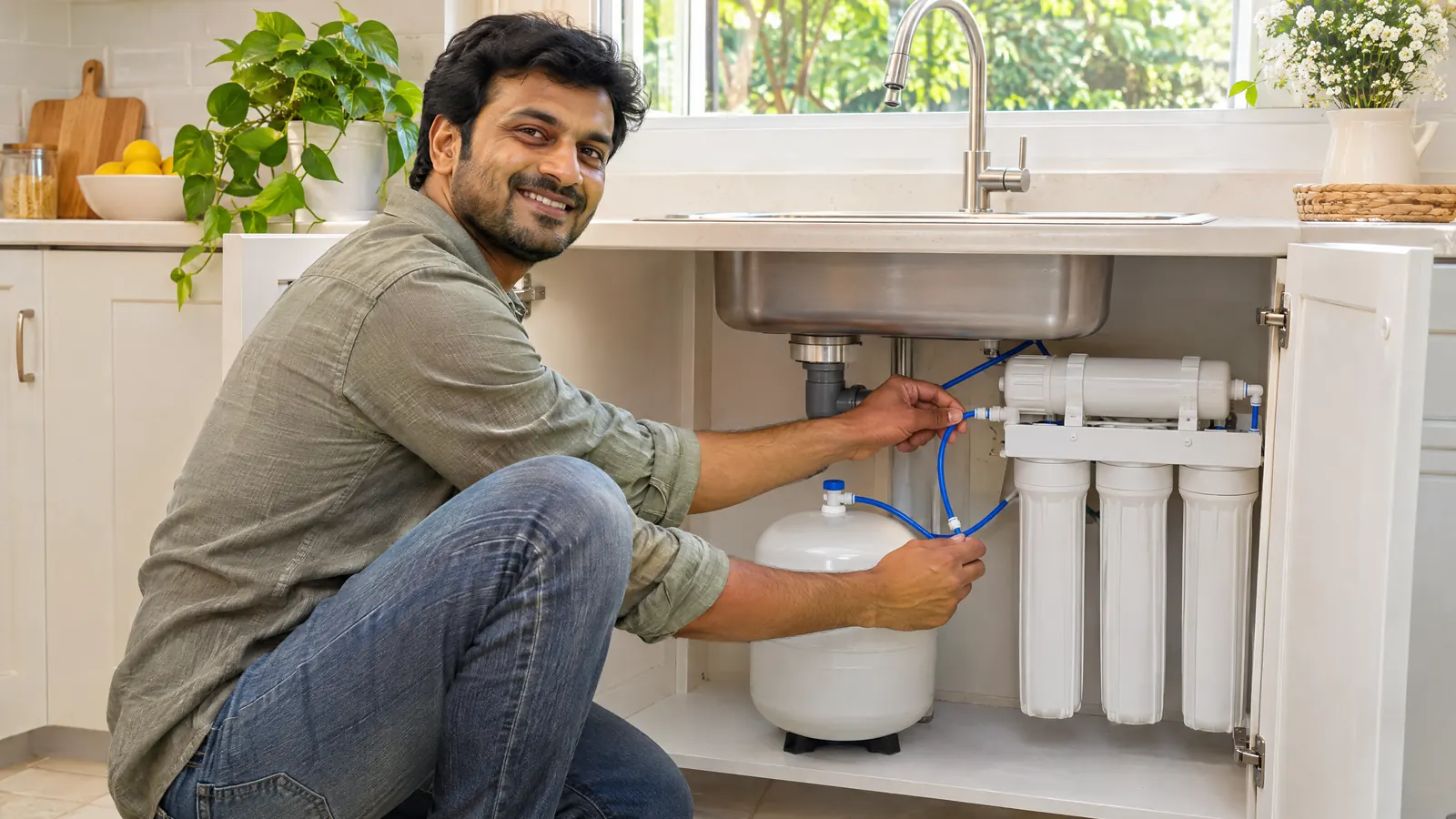
An RO system sends reject water to the drain while it makes treated water, so some draining is normal. It should stop once the storage tank is full. UNL says shut-off valves are there to "stop water flow when the storage tank is full."[1] If it drains with a full tank and a closed faucet, something needs checking. For the bigger picture, see how much water reverse osmosis wastes.
You hear it from the cabinet at night, or you notice the drain tubing is still moving water long after anyone used the RO faucet. It is a common worry, and the answer depends on one thing: whether the tank is full.
Does reverse osmosis constantly drain water?
It should not. An RO membrane splits incoming water in two. EPA WaterSense calls the part that carries away the salts and minerals "reject water," also known as concentrate or brine.[2] That reject water flows to the drain only while the system is producing treated water.
When the storage tank fills, the system is meant to stop. UNL explains that some RO systems have shut-off valves that "stop flow whenever storage tank pressure is too high for efficient recovery."[1] One manufacturer's manual says the same in its own words: when the storage tank is full again, the system "automatically shuts-off thereby saving water."[3]
So draining during a refill is normal. Draining with a full tank and a closed faucet is not.
How long should an RO system drain?
For as long as the tank is refilling. Household tanks are small: UNL says the storage tank generally holds 2 to 5 gallons.[1] Production is slow, though. One manufacturer's manual says its system "requires about 2 to 4 hours to fill the storage tank."[3] Your own system may differ, so check your manual for its figure.
After you use a lot of water, or after a filter or membrane change, expect a longer run. That same manual suggests allowing about three hours after new filters or a new membrane.[3] If the drain is still running well beyond the time your manual gives, treat that as the signal to check further.
Why does my RO waste water keep running?
These are the usual suspects. Which one applies to your system is a job for your manual, the manufacturer or an installer.
- The automatic shut-off valve. This is the part meant to stop flow once the tank is full. UNL says shut-off valves "are important to stop water flow when the storage tank is full, so excess water is not wasted."[1] If it is not closing, water keeps going to the drain.
- The check valve. One manufacturer's parts list names an auto shut-off valve and a check valve as separate parts.[3] Ask the maker what each one does on your model and how to test it.
- Tank air pressure. The storage tank is pressurized, and UNL notes that is what gives adequate flow when the tap opens.[1] One manufacturer's manual lists 7 to 10 psi of air in an empty tank.[3] Because the shut-off responds to tank pressure, a tank that is out of range is one more thing for a pro to check.
- Feed water pressure. UNL says incoming pressure "must be adequate to overcome the osmotic pressure."[1] That same manufacturer lists a feed range of 40 to 80 psi.[3] If the tank fills slowly, the drain runs longer.
- The flow restrictor. UNL calls it the flow regulator on the waste stream and says "Proper adjustment" matters: if waste flow is too fast, "the recovery rate is low and excessive water flows down the drain."[1] The manual above calls its part a drain line flow control and says a flow under 1 1/2 cups per minute with clean pre-filters points to a clogged controller, and to call technical support.[3]
Not sure how much your drain flow really is? Our guide to the RO waste water ratio walks through measuring it, and the printable RO waste check puts the steps on one page.
Why is my RO system constantly draining?
Start with what you can see and hear, without touching anything under the sink.
- Note whether anyone has used the RO faucet in the last few hours. A recent refill explains a running drain.
- Wait out the fill time in your manual, then listen again with the faucet closed.
- Look at the cabinet floor and fittings for drips or damp spots.
- Open your manual to the troubleshooting page and the parts diagram. Find the shut-off valve, the check valve and the drain line flow control.
Anything past this is hands-on. Check your manual first. Turn off the supply valve before you touch any tubing or fittings, and stop if a fitting is unfamiliar. One manufacturer's manual says to close the cold water supply and the tank valve before working on a quick-connect fitting.[3] An installer or plumber can do this work for you. After any job, turn the supply back on and check every fitting for leaks.
Call the manufacturer or your installer if the drain runs with a full tank, if your manual's checks do not settle it, or if you see a leak. Leave the drain connection itself, including any air gap or drain saddle, to a licensed plumber or your local authority.
Frequently asked questions
Why does my reverse osmosis system sound like water is running?
While the system is making water, reject water leaves the membrane and flows through the drain tubing to the drain, so a trickle sound is expected during that time. One manufacturer's manual describes the drain as a gravity line that should free flow. If the sound never stops, even with the tank full, use the checks above and ask the maker or an installer.
Why is my reverse osmosis constantly draining?
If the tank is full and the faucet is closed, the drain should go quiet. UNL says shut-off valves exist to stop flow when the tank is full so water is not wasted. Constant draining points to that shut-off, to tank pressure, or to feed pressure and the drain flow control. Your manual and the manufacturer's support line are the next step.
What if my RO filter won't stop draining unless I turn the tank valve off?
That is a useful clue to pass along, not a fix to rely on. Closing the tank valve is a workaround, not a repair, and leaving it closed means you have no stored water to draw from. Tell your installer or the manufacturer exactly when the drain stops and starts. They can tell you which part to test.
What if my reverse osmosis seems to be constantly running?
Take your manual out and call the maker before you replace anything. Ask which part to test first.
It is also fair to ask whether you need a drain at all. The Sentry H2O Wellness System is not an RO system. It sends no reject water to the drain and needs no drain line or electricity. Read how much water reverse osmosis wastes, then compare both options against your own water report.
Sources
[1] University of Nebraska–Lincoln Extension, NebGuide G1490, Drinking Water Treatment: Reverse Osmosis (2014). Shut-off valves, storage tank size and pressure, feed pressure, flow regulator.
[2] U.S. EPA WaterSense, Point-of-Use Reverse Osmosis Systems. Reject water, concentrate and brine.
[3] American Home Water, Reverse Osmosis Owner's Manual (undated PDF). Cited as one manufacturer's manual: fill time, automatic shut-off, tank and feed pressure, drain flow control, parts list. Your own manual governs your system.
Keep reading
Educational guidance only. This article explains why an RO drain can keep running and cites the U.S. EPA, the University of Nebraska–Lincoln and one manufacturer's manual. It makes no claim about any RO brand.