
Water 101 · 6 min read
How much water does reverse osmosis waste?
A typical under-sink reverse osmosis system sends five gallons or more of water down the drain for every gallon it makes, according to EPA WaterSense. Inefficient units can send up to 10. Systems that earn the WaterSense label must show 2.3 gallons or less. Your own number depends on your water pressure, water temperature and the system itself.[1]
Most people find out about RO waste the same way. The system goes in, the drain line gets clamped to the sink pipe, and later someone hears water running under the cabinet when nobody is using the faucet. That sound is the system doing its job. Here is how much water that job takes.
How much water does reverse osmosis waste?
EPA WaterSense puts it plainly: "a typical point-of-use RO system will generate five gallons or more of reject water for every gallon of treated water produced." Some inefficient units generate up to 10 gallons per gallon. RO systems that earn the WaterSense label must "send just 2.3 gallons of water or less down the drain per gallon of treated water."[1]
| RO system | Down the drain per gallon you drink | For 10 gallons you drink |
|---|---|---|
| WaterSense labeled | 2.3 gallons or less | 23 gallons or less |
| Typical | 5 gallons or more | 50 gallons or more |
| Inefficient | Up to 10 gallons | Up to 100 gallons |
Per-gallon figures: EPA WaterSense.[1] The right-hand column multiplies them by 10.
The numbers on a box are often given as a ratio, like 3:1 or 1:1. We explain what those mean, and how to measure your own, in reverse osmosis waste water ratio, explained.
Why does reverse osmosis waste water?
An RO membrane works by holding back most of what is dissolved in your water. What it holds back has to go somewhere. The University of Nebraska–Lincoln's guide to RO describes it this way: "Part of the water fed into the system is used as wastewater to wash away the rejected contaminants."[2] Without that rinse, the membrane would clog.
The same guide says most household RO systems are designed with a 20 to 30 percent recovery rate. That is the share of incoming water that comes out of your faucet. At 20 percent, a system fed 100 gallons a day makes 20 gallons of treated water and sends 80 gallons to the waste stream.[2]
Three things push your own number up or down:
- Water pressure. Incoming pressure must be high enough to overcome the osmotic pressure, and a higher pressure difference across the membrane gives better rejection.[2]
- Water temperature. UNL reports a 1 to 2 percent drop in treated water for every degree below the standard 77°F. Well water at 45°F would make about half as much as it would at 77°F.[2]
- The tank shut-off. Most systems fill a storage tank, which UNL puts at 2 to 5 gallons. A shut-off valve stops the flow when the tank is full "so excess water is not wasted."[2] A valve that fails to close lets water run to the drain. See why an RO drain keeps running for the usual causes.
How much water does reverse osmosis waste per year?
That depends on how much RO water your household draws, so there is no honest single number. The math is simple, though: gallons you draw per day, times the gallons your system sends to the drain per gallon made, times 365.
EPA's own estimate gives a sense of scale. It says choosing a WaterSense labeled model will reduce water use by more than 3,100 gallons per year on average, which works out to 47,000 gallons over the lifetime of the system.[1] That is the difference between an efficient unit and a typical one, not the total waste.
To run the numbers for your own sink, use our free RO waste check. It has a jug-and-timer test and a one-page worksheet you can print.
Frequently asked questions
Is reverse osmosis wasteful?
It uses more water than it delivers. EPA WaterSense says a typical point-of-use RO system generates five gallons or more of reject water for every gallon of treated water. Labeled systems must show 2.3 gallons or less. Whether that trade is worth it depends on what is in your water.
Can I use RO waste water for plants and gardening?
The reject stream carries the dissolved minerals and other substances the membrane held back, so it is more concentrated than your tap water. Whether it suits a given plant depends on what is in your source water. Check your water report, and ask your local extension office before you water anything sensitive with it.
Which systems waste the least water?
If you want RO, look for the WaterSense label. Those systems must show they send 2.3 gallons or less down the drain per gallon, and EPA says the label also checks that the membrane lasts at least a year before it needs replacing.[1] For the bigger decision, our guide on whether reverse osmosis is worth it covers the costs past the water bill. Already own one? Our guide on how to reduce reverse osmosis waste water covers the fixes, and what to do with RO waste water covers the reject stream itself. On a septic system, read reverse osmosis and septic systems.
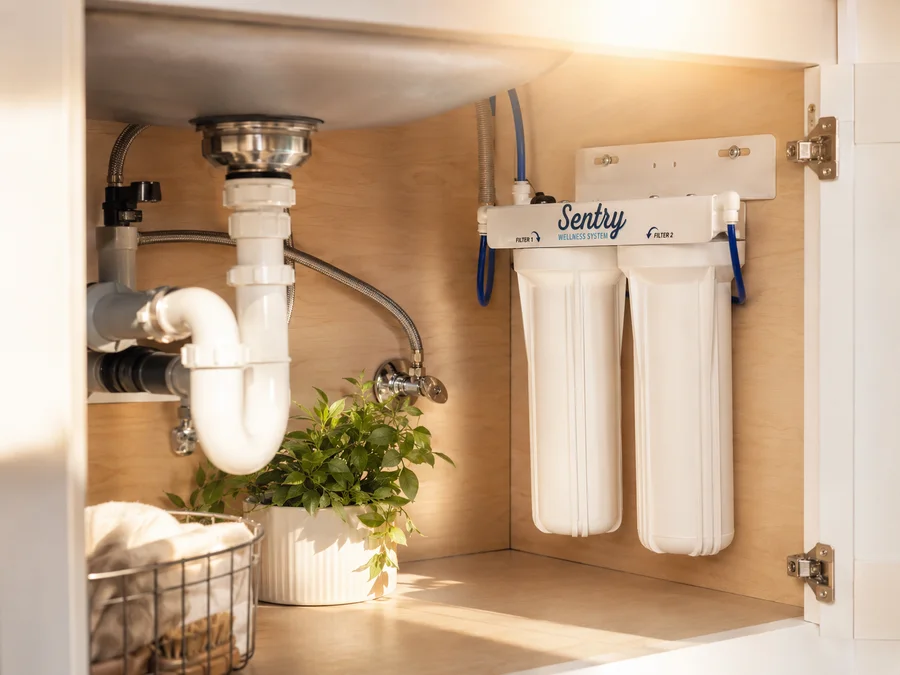
If RO is more than your water needs, there are filters that send no water to the drain. The Sentry H2O Wellness System is that kind of system. It is not an RO system. It sends no reject water to the drain, needs no drain line and runs on no electricity. Read our honest comparison of RO and carbon filtration first, including where RO wins, then decide which fits your water.
Sources
[1] U.S. EPA WaterSense, Point-of-Use Reverse Osmosis Systems (last updated August 21, 2026). Reject water per gallon, the 2.3-gallon label limit, yearly and lifetime savings, membrane life.
[2] University of Nebraska–Lincoln Extension, NebGuide G1490, Drinking Water Treatment: Reverse Osmosis (2014). Recovery rate, pressure, temperature, storage tank and shut-off valve.
Keep reading
Educational guidance only. This article explains how reverse osmosis systems use water and cites the U.S. EPA and the University of Nebraska–Lincoln. It makes no claim about any RO brand.